


How ranging-while-drilling takes days, dollars, and risk out of your AFE, and why the way we all pay for well control has to change with it.
I want to make a cost argument, not an engineering one. The engineering behind active magnetic ranging has been presented at conferences and reaffirmed in a patent office. What has not been argued clearly enough, and what I think matters most to the people who actually sign an AFE, is the financial one: a relief well drilled with ranging integrated into the drillstring is not just safer and faster than the conventional approach. It is dramatically cheaper, and it exposes a pricing model this industry has never questioned.
There is a well-known idea in business strategy, which Kim and Mauborgne named value innovation in their book Blue Ocean Strategy: the rare move that raises the value a buyer receives while simultaneously lowering the cost to deliver it, breaking the trade-off that everyone else treats as fixed. That is the one and only time I will name the framework, because the point of this piece is not to admire a business book. It is to show operators, and specifically the finance and drilling-cost people inside them, that this move has already happened in well control, that it is quietly sitting in your contingency plans as an option most plans still treat as a last resort, and that capturing its full value requires changing not just the technology you choose but the way you pay for it.
The trade-off you have been quoting for decades
When a well goes out of control, the industry has historically offered two answers that sit at opposite ends of one trade-off. You can intervene at the surface, working on the flowing and sometimes burning wellhead, which is intense and open-ended in duration. Or you can drill a relief well from a safe standoff distance and kill the well from below, which is lower risk but has historically taken 30 to 90 days to reach the target, which is exactly why it was held back as the last resort.
Every provider in that market competed inside those terms. They argued about who was a little faster, who was a little more precise, whose crews were a little more experienced. When competitors all offer more or less of the same things, you can draw it as a value curve: plot the factors buyers weigh across the bottom, the level each provider offers up the side, and the incumbents trace roughly parallel lines. Nobody is different. Everybody is negotiating position on the same axes, and margins compress accordingly.
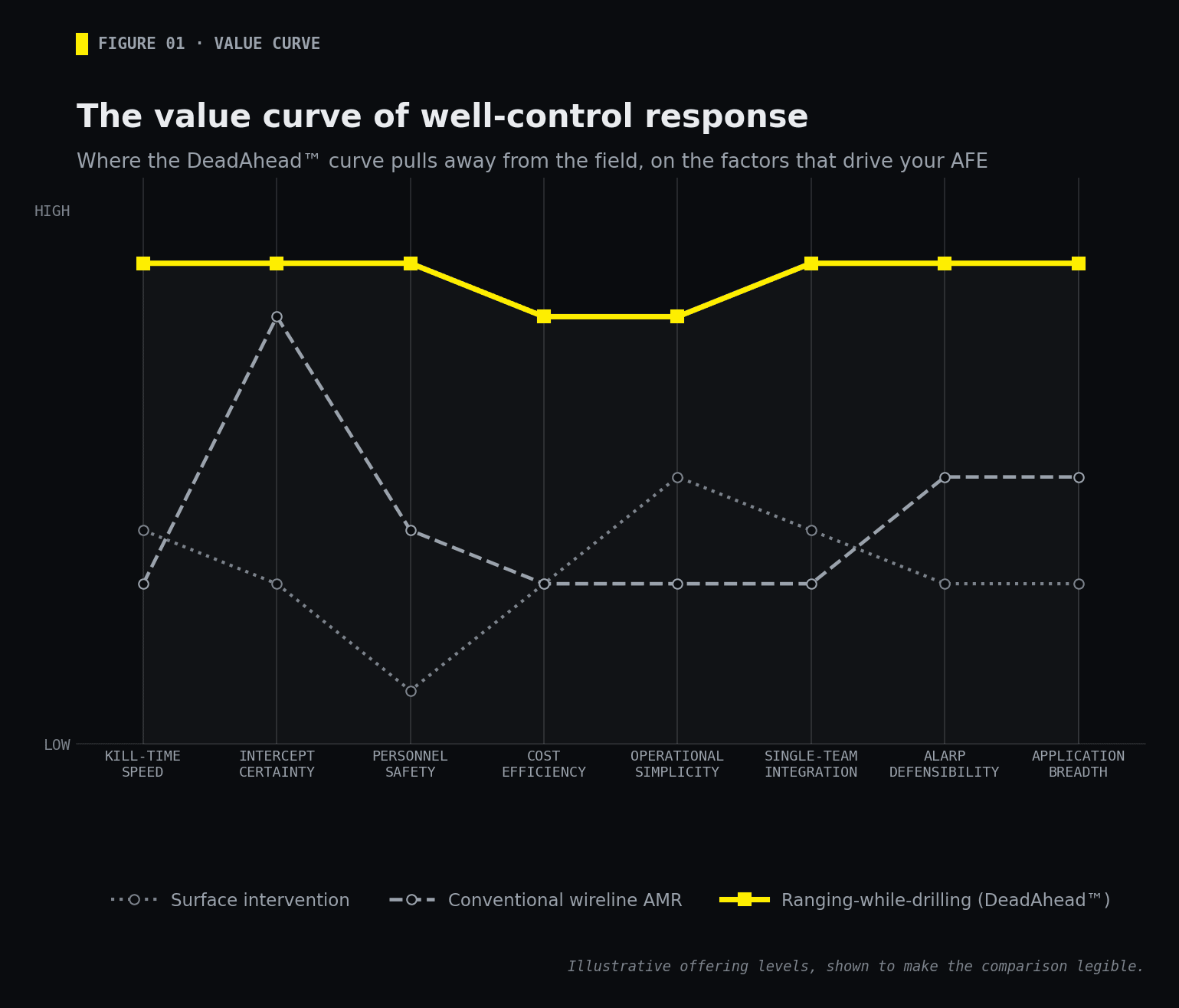
Ranging-while-drilling does not trace a parallel line. It sits high on factors the old market treated as fixed constraints, including kill-time speed, personnel safety, operational simplicity, and cost efficiency, because it changes what a relief well fundamentally is. When ranging never leaves the drillstring, the relief well stops being a specialized, repeatedly interrupted, multi-vendor campaign and becomes, in the plain words our crews use, a directional-drilling job. That divergence is the whole point, and it is where the savings live.
Where your AFE actually goes, and what disappears
Here is the number that should get a CFO's attention: ranging-while-drilling reduces relief-well AFE by roughly 50 to 75 percent. I want to be precise about why, because the reason matters more than the figure. This is not a discount. We did not sharpen a pencil on a bid. The cost comes out because the cost drivers are engineered out of the well.
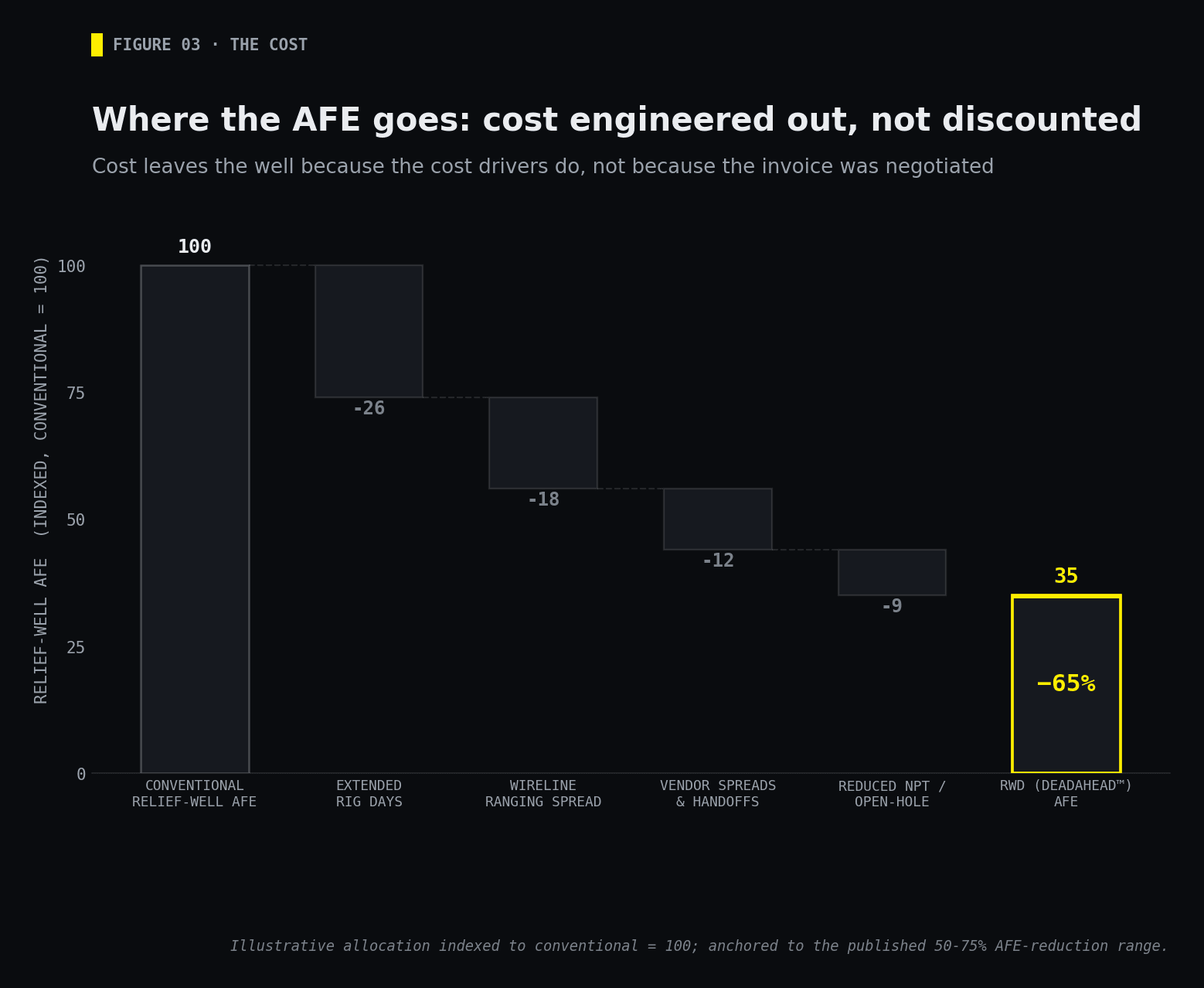
Walk the cost of a conventional wireline-ranged relief well. It carries extended rig days, because the intercept takes 30 to 90 days. And rig days are not cheap days. On land they run into the tens of thousands of dollars per day once you count the rig and its attendant services, and offshore the all-in cost of a drilling rig and its third-party spreads can approach a million dollars a day. At that rate, the arithmetic is brutally simple: every single day you shorten the intercept is on the order of a million dollars back on the AFE, before you have saved a cent anywhere else. On top of the rig, the conventional method carries a full wireline ranging spread, rigged up and run more than twenty times across a typical campaign, and multiple vendor spreads, each with its own day rate, mobilization, standby, and the handoffs between them. And it carries the non-productive time that piles up every time the assembly comes out of the hole for a survey. Those are not small line items. Priced by the day, they are most of the invoice.
Ranging-while-drilling deletes them rather than trimming them. There are no wireline ranging runs and no assembly trips for ranging, because ranging is in the drillstring and takes roughly eight minutes per survey while drilling continues. There is one integrated crew instead of a stack of vendor spreads. Circulation and pressure control stay intact survey after survey, so the open-hole waiting time never accumulates. What is left is a fraction of the original cost, and it is a smaller cost precisely because it is faster and safer. Lower cost and higher value here are the same act, performed once.
The same logic applies to the safety ledger, which for a modern operator is also a financial ledger. Cumulative human exposure, measured in person-hours spent in the hazard zone, falls by roughly 90 percent, from something like 2,700 red-zone person-hours on a conventional campaign to something like 240 on a ranging-while-drilling campaign. Even holding the per-hour risk of every task constant, cutting the hours in the zone by about 90 percent cuts the cumulative chance of a recordable incident by about 90 percent. Duration is the variable that compounds, and duration is what collapses.
Set side by side, the change is easy to itemize: what leaves the cost structure, and what gets added to buyer value in its place.
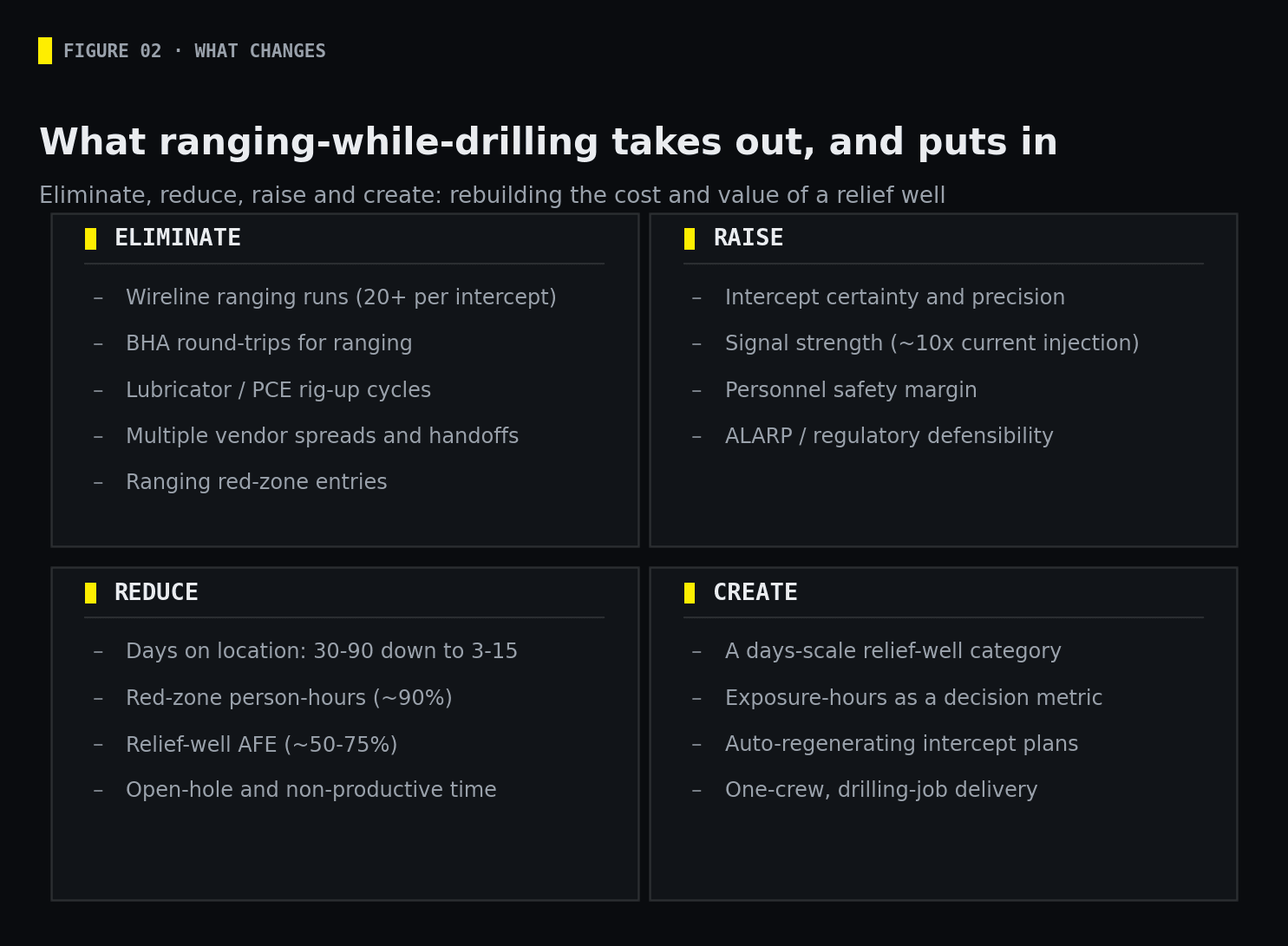
Out go the twenty-plus wireline runs, the assembly round-trips, the lubricator rig-ups, the multiple vendor interfaces, and the red-zone entries each of those required. Days on location fall from 30-to-90 down to 3-to-15. AFE falls by half or more. In their place you get higher intercept certainty, a stronger ranging signal at longer range, a far larger safety margin, and something that did not exist before: a genuinely days-scale relief well, delivered by one crew, with an intercept plan that updates in software after every survey.
The incentive nobody puts in the AFE: the day rate

Now the part that I think is the real story, and the reason this technology has taken longer to become standard than its economics deserve.
This industry runs on day rates. Rigs, well-control specialists, wireline spreads, and most of the services around them are billed by the day, by the run, or by the piece. That convention is so old and so universal that we rarely notice what it does to incentives. A day rate means the provider's revenue rises with time on location and with the number of runs performed. Read that sentence again from the seat of someone paying the invoice. Under the traditional model, the service company that finishes in fifteen days earns less than the one that takes forty-five, and the one that eliminates twenty wireline runs earns less than the one that bills for all twenty. There is no financial reward for speed. If anything, the meter rewards its opposite.
I am not accusing anyone of running the clock. The vast majority of people in well control are trying to kill the well as fast as they safely can. The problem is structural, not moral. When the pricing model pays for time and activity, the market as a whole under-invests in the very thing the operator, the insurer, and the public most want, which is a fast, clean kill. The incentive quietly points the wrong way, and it has pointed that way for so long that the cost of slowness has come to look like an unavoidable feature of the work rather than a feature of the invoice.
Ranging-while-drilling makes that misalignment impossible to ignore, because it can genuinely finish in days. Under a pure day-rate model, our own efficiency would be a revenue problem: the faster and cleaner we make the job, the less a day-rate meter would let us bill for it. Any technology that is paid by the day is punished for being fast. That is not a footnote. It is the central reason a paradigm this good needs a pricing paradigm to match.
A new way to pay: price the outcome, not the clock
The fix is to price the outcome rather than the time. When the objective is defined the way the standards bodies define it, stop the flow and stabilize the well, then the fee should attach to achieving that outcome safely and quickly, not to the number of days and runs it takes to get there. Fixed-scope pricing to a defined kill, milestone pricing tied to intercept and control, and performance structures that reward speed all put the provider and the operator on the same side of the clock for the first time.
This is only rational because the technology makes speed reliable rather than lucky. You cannot responsibly price to an outcome when the method is a twenty-run campaign of uncertain length. You can price to an outcome when ranging is deterministic, integrated, and days-scale, with a 100 percent intercept record across the projects that back it. The technology and the pricing model are two halves of the same move: value innovation on the supply side, incentive alignment on the commercial side.
Look at who wins when the clock stops being the meter. The operator wins, because the AFE falls by half or more and the exposure falls by about 90 percent. The insurer wins, because nearly every control-of-well cost scales with days flowing, so a shorter kill is a smaller claim. The public wins, and this matters more than the industry usually admits: many of these events involve orphaned or legacy wells where the state, and ultimately the taxpayer, funds the plugging, and every uncontrolled well flows pollution that someone has to clean up by the day. And the service provider wins, because it earns on efficiency, throughput, and reputation rather than on delay, and because it can offer a price an operator can actually plan around. The only thing that loses is the clock. When we are paid to be fast, we are free to deploy a technology whose entire advantage is speed, and everyone downstream of the invoice keeps the savings.
The underwriter already agrees, and so does the regulator
If the incentive argument feels novel, the insurance market has been quietly making the money version of it for years. A typical well-control claim runs in the range of 3 to 13 million dollars, and the market's reference catastrophe, a single 2010 Gulf of Mexico blowout, carries cumulative cost north of 65 billion dollars. Offshore energy premiums rose 20 to 25 percent after 2010, and control-of-well premiums rose 9.2 percent year on year into 2025. Underwriters already fund pre-event planning and reward demonstrated preparedness, because they understand that the cheapest claim is the short one. A documented, days-scale kill capability is one of the largest levers left on that loss ratio, which means it should show up not only in your AFE but in your cost of risk.
The law points the same way. The ALARP standard that governs major-hazard risk in several jurisdictions requires reducing risk further unless the cost of doing so is grossly disproportionate to the benefit, and, critically, the bar moves as technology improves. Regulators state in their own guidance that a new capability can make a higher standard reasonably practicable. Once a relief well can kill a well in days, the justification for accepting weeks of exposure, and weeks of daily cost, gets harder to sustain each year. Finance, insurance, and regulation are, for once, pulling in the same direction.
A bigger market, not a bigger slice
There is a growth story hiding inside the cost story, and it also lands on the operator's ledger. When the intercept costs days instead of months and the AFE falls by half, a relief well stops being an exotic response reserved for the largest operators facing the worst events. It becomes an ordinary, plannable, affordable engineering option, which means it starts to fit problems it never fit before.
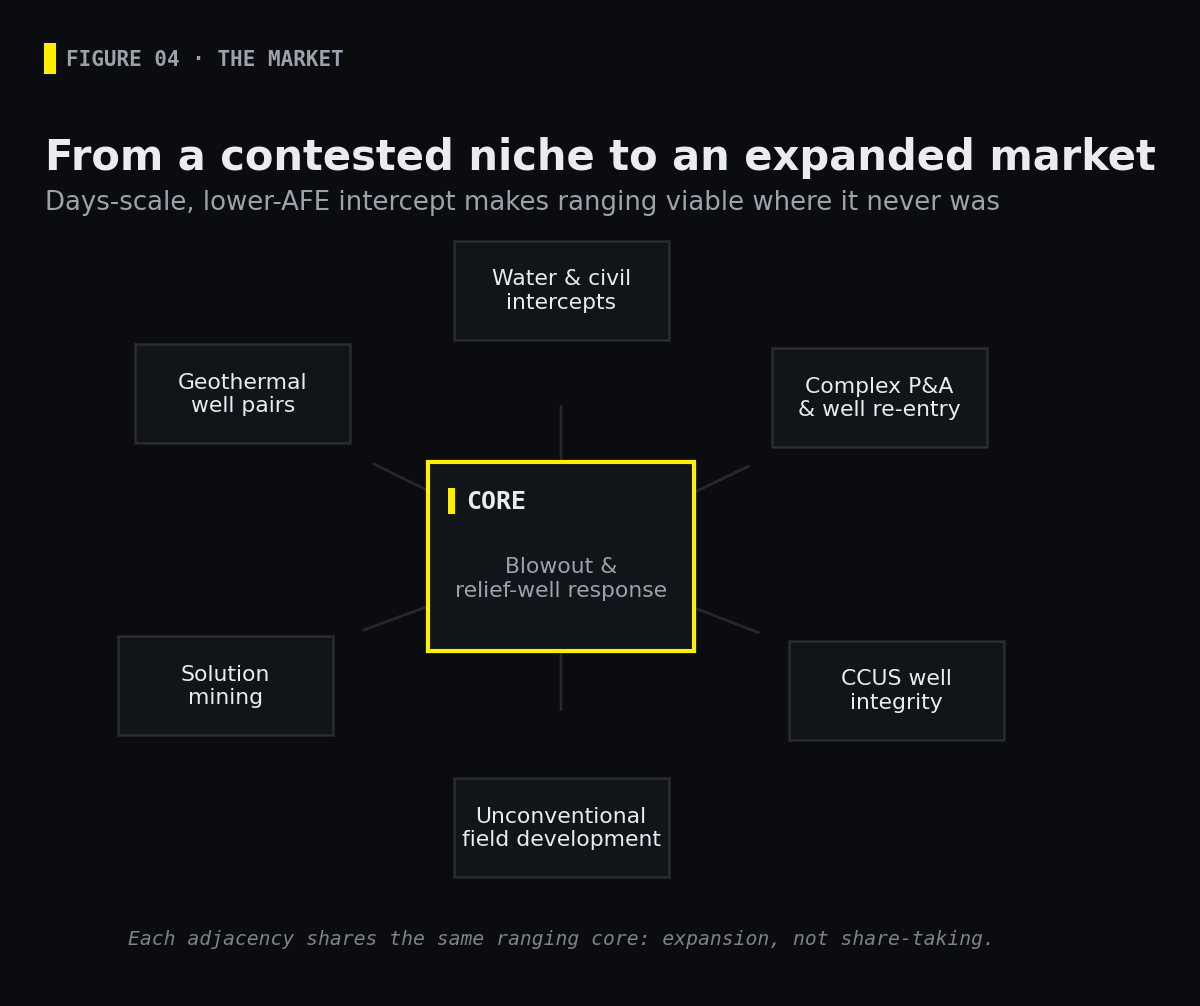
The same ranging core that kills a blowout also connects a geothermal well pair, restores integrity to a carbon-storage well, executes a complex plug-and-abandonment where conventional re-entry has failed, links a solution-mining cavern, and threads intercepts for water and civil infrastructure. For an operator, that is not abstract market expansion. It means more of your difficult, previously uneconomic problem wells become solvable at a cost that clears an economic hurdle. The market did not get carved up more finely. It got larger, because the price of solving a whole class of problems fell.
On the record, not on a slide
Strategy diagrams are clean, so the fair test is field results. In 2026, a major operator in the Permian Basin faced an uncontrolled release of more than 8,000 barrels a day. A ranging-while-drilling relief well located the target at a world-record 306 feet center-to-center, roughly six times the longest prior ranging range, and achieved a dynamic kill about 72 hours from spud, with the relief well, kill, and permanent abandonment complete in under a week, against an industry norm to intercept of 30 to 90 days.
Read the 2026 Permian case study →In 2025, the world-first wired-pipe deployment threaded a relief well through a window only about ten feet wide below a stuck packer, in conditions where conventional wireline ranging struggles, hitting the exact planned depth, avoiding more than ten wireline runs and roughly two weeks of rig time, and saving on the order of 2 million dollars against a wireline campaign.
Read the 2025 North Dakota case study →And a legacy blowout in Louisiana that had resisted 116 days of surface intervention was killed in 15 days once ranging located it from below, the same well, both methods, on the public record, with roughly 2 million dollars saved.
Read the Louisiana blowout case study →Across a portfolio of 49 delivered projects, including more than a dozen relief-well and blowout jobs across seven countries, the intercept success rate is 100 percent.
What to ask for

If you carry responsibility for how your organization buys well-control response, three asks follow directly from the numbers above. First, put two lines into every response-option evaluation alongside probability of success: estimated days to kill, and estimated cumulative exposure hours. What gets measured gets engineered down, and both of those numbers translate straight into cost and into your loss ratio. Second, ask your providers for outcome-based pricing, and treat any model that only pays by the day as the warning sign it is, because it means nobody across the table is financially rewarded for finishing your problem quickly. Third, pre-plan the fast relief well before you need it, with spud locations, ranging method, and permits agreed in advance, and run that lane in parallel from hour one rather than after a surface loop has spent its weeks and its dollars.
For most of this industry's history, the safest response and the cheapest response were in tension, and every well-control plan was a compromise between them, priced by a meter that rewarded the compromise. That is no longer true. The fastest kill is now the safest kill and the cheapest kill at the same time, and the only thing standing between an operator and those savings is a pricing habit older than the technology it constrains. Change the habit, and the incentive finally points where everyone wanted it to point all along: stop the flow, stabilize the well, and bring everyone home, as fast as humanly possible.
Selected figures (AFE reduction, exposure-hour modeling, response durations, and case results) are drawn from Gunnar Energy Services' published materials and public field records; insurance and ALARP figures are from cited industry and regulatory sources. The AFE waterfall is indexed to a conventional baseline of 100 and is illustrative, anchored to the published 50 to 75 percent reduction range. Value-curve levels are illustrative, shown to make the shape of the comparison legible.
- Ranging-while-drilling cuts relief-well AFE by roughly 50 to 75 percent, not by discounting but by engineering out the cost drivers: extended rig days, 20+ wireline runs, multiple vendor spreads, and non-productive time.
- Every day cut from a 30-to-90-day intercept is real money, on the order of ~$1M/day offshore, and cumulative exposure hours fall about 90 percent alongside it.
- The day-rate model quietly rewards slowness; pricing the outcome (a defined, safe, fast kill) puts operator, insurer, public and provider on the same side of the clock.
- ALARP and the insurance loss ratio both favor a documented, days-scale kill, so it belongs in your AFE and your cost of risk, not just your engineering plan.